The Arum Lily (botanical name Zantedeschia aethiopica)
- justmeinmygarden23
- Jun 16, 2025
- 2 min read
Updated: Aug 18, 2025
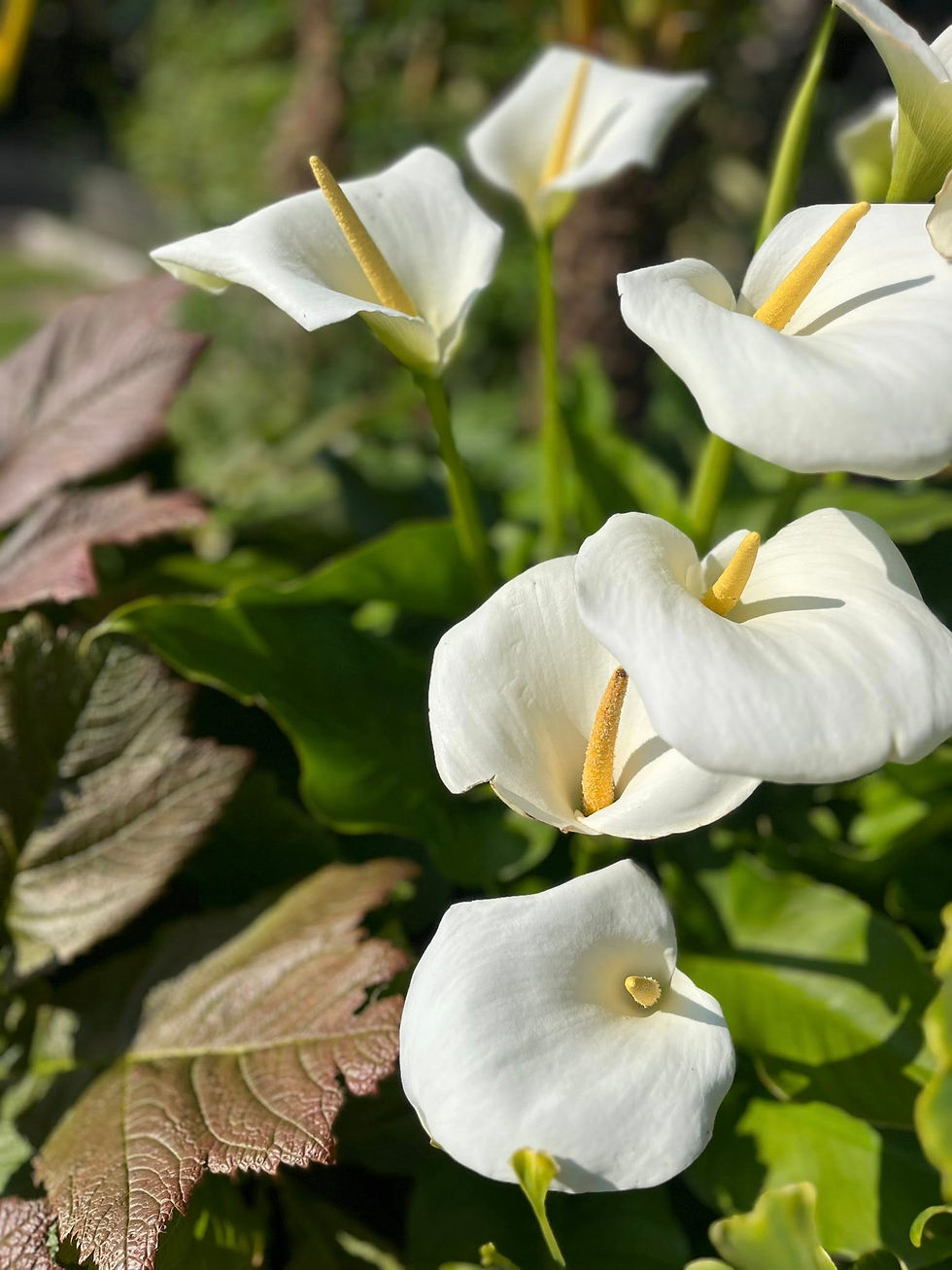
The Arum Lily is looking lovely at the moment in the garden, I appreciate the simplicity of the funnel-shaped white spathes of this clump-forming herbaceous perennial. (Spathes are formed from a single petal-like bract and are the scrolled, trumpet or chalice shaped flowers that Zantedeschias produce).
It can be semi-evergreen in some parts but my coastal northern garden means it does die back over winter, before the erect, long-stalked, dark glossy green, arrow-shaped leaves begin to emerge again in spring.
The tiny yellow true flowers that form on the dense spike-like spadices attract many pollinators both during the day and at night. The whites spathes acting as night lanterns to attract the night visitors. Later, in autumn, there is further interest when those pollinated flowers develop into pointed orange berry-like fruits.
As with many of my plants, there are multiple plantings in different positions in my garden: of this there is one in the pond and one in a large tub in a
tropical area; the tub has few drilled holes as it does prefer damp or poorly drained conditions.
Although I’ve only ever heard this referred to as an Arum Lily in my small ‘corner’ of the world, it does have many other common names: African lily, Egyptian lily, lily of the Nile, altar lily, calla lily, richardia & trumpet lily; all easier to pronounce than it’s botanical name, & one I always use the common name of as I feel it is fitting with the aesthetic simplicity of this beautiful plant.




Comments